
WAEC 2022 Physics · Paper 3 (practical)
Moments: metre rule on a knife edge
WAEC Physics practical past question · Mechanics
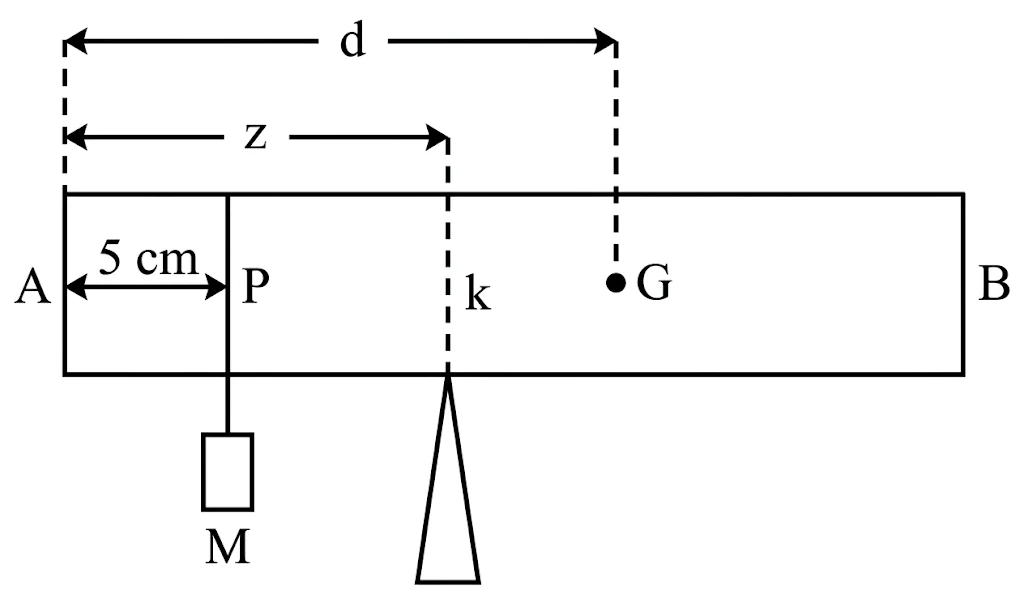
You are provided with a metre rule, a weight hanger, slotted masses, M, a piece of string, a weighing balance and a knife edge. Use the diagram above as a guide to perform the experiment.
You are provided with
- Mslotted masses
- metre rule
- weight hanger
- piece of string
- weighing balance
- knife edge
- (a)
- (i)Procedure
Using the weighing balance, determine and record the mass, , of the unloaded metre rule.
- (ii)Procedure
Determine and record the mass, m, of the weight hanger.
- (iii)Procedure
Suspend the metre rule horizontally on the knife edge. Adjust the knife edge to a point G on the metre rule where it balances horizontally.
- (iv)Procedure
Record the distance, d = AG.
- (v)Procedure
Suspend the weight hanger securely at a point, P, on the metre rule such that AP = 5 cm. Keep the hanger at this point throughout the experiment
- (vi)Procedure
Add a mass, M = 20 g to the hanger, adjust the knife edge to a point K on the metre rule such that it balances horizontally as shown in the diagram above.
- (vii)Procedure
Determine and record the distance z = AK.
- (viii)Procedure
Record M and evaluate , and
- (ix)Procedure
Repeat the experiment for M = 40 g, 60 g, 80 g and 100 g. In each case, evaluate y, x and v.
- (x)Record
Tabulate the results.
- (xi)Graph
Plot a graph with M on the vertical axis and v on the horizontal axis, starting both axes from the origin (0,0).
- (xii)Calculation
Determine the slope, s, of the graph.
- (xiii)Calculation
Determine the intercept, c, on the vertical axis.
- (xiv)Precautions
State two precautions taken to ensure accurate results.
- (i)
- (b)
- (i)Written answer
Under what condition is an object said to be in a stable equilibrium
- (ii)Written answer
A uniform beam of weight 50 N has a body of weight 100 N hung at one end of it. If the beam is 12 m long, determine the distance of a support from a 100 N body for it to balance horizontally.
- (i)
What this practical asks you to do
- Carry out the experiment as the paper describes (parts (a)(i), (a)(ii), (a)(iii), (a)(iv), (a)(v), (a)(vi), (a)(vii), (a)(viii), (a)(ix))
- Record your readings or observations in a table (part (a)(x))
- Plot a graph of your results (part (a)(xi))
- Calculate or determine values from your results (parts (a)(xii), (a)(xiii))
- State the precautions you took (part (a)(xiv))
- Answer written questions (parts (b)(i), (b)(ii))
This page shows the question as printed. Your readings, observations and answers come from your own work, so none are given here.
Past questions © the examination body (WAEC). DeeepSolve is not affiliated with it. Rights holders: see /copyright.